
How to Reduce Slippage in Trading: Practical Techniques for More Accurate Order Execution

Dhruva G
AuthorPublished December 9, 2025
How to Reduce Slippage in Trading: Practical Techniques for More Accurate Execution
Slippage is one of the most common and costly execution issues faced by active traders. It occurs quietly, especially during volatile periods, and often erodes profitability before a strategy even gets a chance to perform. Understanding what slippage is, why it occurs, and how to reduce it can significantly improve your overall win rate and risk control.
This guide explains slippage in simple terms, outlines the major causes, and provides practical ways to minimize it along with a brief look at how certain execution tools can help support cleaner fills.
What Is Slippage?
Slippage is the difference between the price you expect to receive when placing an order and the price at which your order gets filled.
For example, if you attempt to buy at ₹100 but your fill arrives at ₹103 during a fast move, that ₹3 difference is slippage.
Slippage affects intraday traders, scalpers, option buyers and sellers, and anyone working in fast-moving markets.
Why Slippage Happens
Slippage usually occurs due to one or more of the following:
1. High Volatility
Rapid price changes create situations where the market moves away before your order can execute.
2. Low Liquidity
When there aren’t enough orders at your expected price level, your order gets filled at worse prices.
3. Delayed Manual Execution
During fast markets, even a small delay in order placement can push traders into poor fills.
4. Market Orders Without Protection
Pure market orders fill at the best available price sometimes far beyond what the trader intended.
Understanding these causes helps traders focus on the execution improvements that matter most.
How to Reduce Slippage: Practical Methods
Below are effective ways traders can minimize slippage without overcomplicating their workflow.
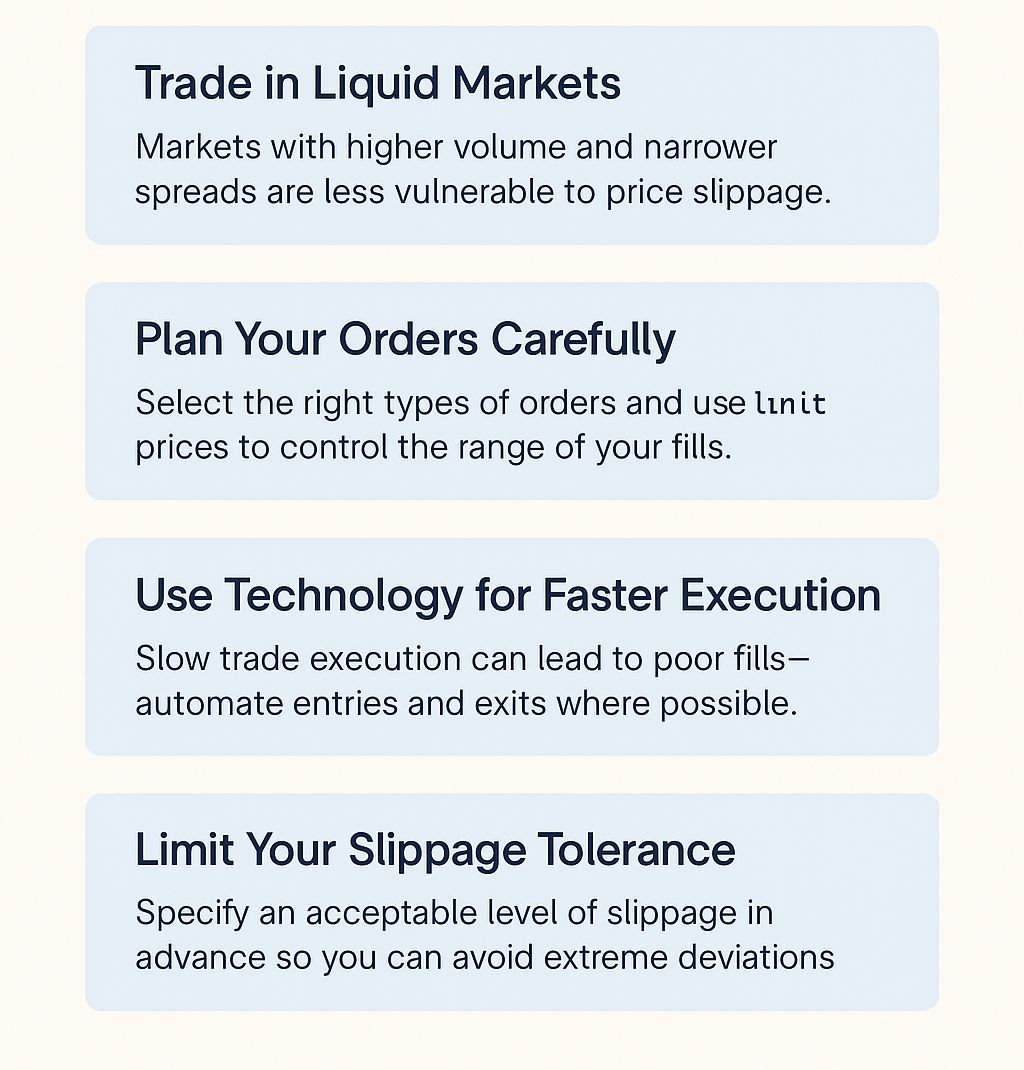
1. Prefer Limit Orders in Volatile Conditions
Limit orders allow you to define the maximum price you’re willing to pay or the minimum price you’re willing to accept.
This prevents unexpected fills but may reduce the chances of instantaneous execution.
Useful when:
Markets are moving quickly
Liquidity is thin
You have defined levels for entry and exit
2. Avoid Trading During Extreme Spikes
Many traders experience the worst slippage during:
Market open
Major news events
Sudden spikes in volume
Reducing position size or avoiding trades during these windows can significantly improve order quality.
3. Execute Faster and Reduce Manual Steps
Every additional click increases the likelihood of a worse fill.
Building a workflow that reduces manual timing issues will naturally reduce slippage.
This includes:
Predefined stop-loss and target levels
Faster entry/exit processes
Automated triggers when possible
4. Use Tools That Add Price Protection
Modern trading terminals offer protective mechanisms that reduce the risk of orders filling far beyond intended prices.
One such example is TRADO’s Market Protection
What it does:
Prevents your market order from executing outside your acceptable price range.
Example:
If you intend to buy an option at ₹120 but want to avoid paying above ₹123 during volatility, Market Protection ensures your order will not fill beyond your defined threshold. You gain the speed of a market order without absorbing the worst of the price spikes.
This is especially useful for traders who need quick execution but still want to maintain control over their fill range.
5. Automate Exits Based on MTM Levels
From a risk perspective, slippage doesn’t only affect entries it also impacts exits.
Tools like MTM Target and MTM Stop-Loss, available on TRADO, help automate exits before volatility widens too much.
This reduces the delay caused by manual reactions and protects traders from deeper-than-expected losses.
Example:
If your daily loss limit is ₹2,000, an MTM Stop-Loss closes all positions automatically when that threshold is reached, preventing slippage from turning a controlled loss into a much larger one.
Conclusion
Slippage is unavoidable, but it can be controlled through disciplined execution and the right tools. By relying on limit orders during volatility, timing trades better, simplifying your execution flow, and applying protective mechanisms such as price-bounded market protection, traders can significantly reduce unnecessary losses.
Good execution is often the difference between a reliable strategy and one that struggles. Reducing slippage is one of the simplest ways to improve overall performance without changing your entire trading approach.
Sign up for updates
TRADO is a Software as a Service (SaaS) Company & your gateway to seamless and empowered trading experience. We specialize in crafting innovative solutions to enhance the journey of traders. Built by Skilled IITians & Experienced Traders, combines cutting-edge technology with user-friendly interfaces, ensuring that you trade with efficiency, accuracy, and confidence.
© 2026 Windigotrade Pvt Ltd. All rights reserved.
Charts are powered by TradingView